
24/7 Emergency Response
Mold Remediation After Water Damage in Kenosha, WI
Water damage can create the perfect conditions for mold growth in as little as 24 to 48 hours. Our team provides mold inspection, containment, HEPA filtration, mold removal, structural drying, and complete restoration services throughout Kenosha County.
- 24/7 Emergency Response
- Mold Remediation Specialists
- Advanced Moisture Detection
- IICRC Standards
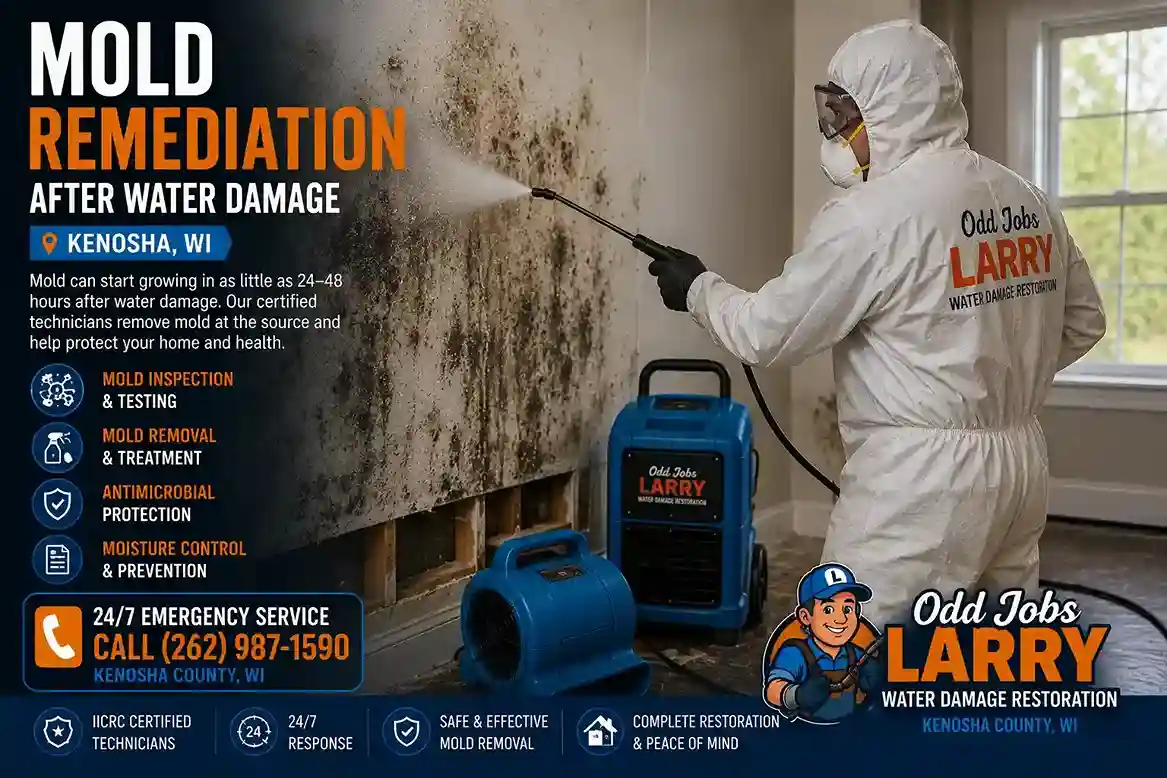
How Fast Can Mold Grow After Water Damage?
Mold can begin developing within 24 to 48 hours after water damage, and hidden moisture behind walls or under flooring is the biggest risk since it's out of sight. Drywall, insulation, wood framing, carpet, and subfloors are all vulnerable once they stay wet. Following IICRC S500 and S520 guidance, immediate water extraction and structural drying after leaks, floods, burst pipes, sewage backups, or appliance failures is the most effective way to reduce mold growth before it starts.
What Causes Mold
Why Mold Develops After Water Damage
Mold needs moisture, and water-damaged building materials that remain wet beyond 24-48 hours carry a significantly increased mold risk, especially with Kenosha's Lake Michigan humidity.
Burst Pipes
Sudden moisture intrusion into walls and flooring.
Basement Flooding
Sump pump failure leaves standing water for hours.
Roof Leaks
Slow, hidden moisture behind ceilings and insulation.
Appliance Leaks
Water heaters and washers leak unnoticed for days.
Sewage Backups
Category 3 water carries contamination and moisture risk.
Storm & Flood Damage
Lake Michigan downpours saturate structural materials.
Hidden Plumbing Leaks
Slab and wall leaks go undetected the longest.
High Indoor Humidity
Poor ventilation compounds existing moisture intrusion.
Warning Signs
Common Signs of Mold Growth After Water Damage
Mold often develops behind walls and under flooring before it becomes visible. These are the signs Kenosha homeowners notice first.
Musty Odors
Visible Mold Spots
Water Stains
Bubbling Paint
Peeling Drywall
Warped Flooring
Allergy Symptoms
Persistent Dampness
Mold Identification
Common Types of Mold Found After Water Damage
Every mold species is moisture-dependent, which is why correcting the water source is as important as removal itself.
Stachybotrys (Black Mold)
Grows on consistently wet, cellulose-rich materials like drywall paper and needs professional assessment and containment.
Aspergillus
A common indoor mold that can affect indoor air quality and is often found on drywall, insulation, and dust.
Penicillium
Frequently spreads quickly on water-damaged carpet, wallpaper, and insulation after flooding events.
Cladosporium
Tolerates a wider temperature range and is often found on damp wood framing and fabrics.
Our Mold Remediation Process
An 8-Step Process Built on IICRC S520 Standards
From first inspection to final clearance, every step is documented for you and your insurance carrier.
Inspection & Moisture Assessment
Moisture mapping and thermal imaging identify the full extent of intrusion.
Mold Testing (When Appropriate)
Sampling confirms species and scope before remediation begins.
Containment Setup
Containment barriers and negative air pressure isolate the work area.
HEPA Air Filtration
Air scrubbers and negative air machines capture airborne spores.
Removal of Contaminated Materials
Porous materials that can't be sanitized are removed and disposed of properly.
Antimicrobial Treatment
Remaining surfaces are treated to inhibit future growth.
Structural Drying
Industrial drying equipment brings moisture readings back to normal.
Restoration & Clearance Verification
Final moisture checks confirm the space is dry and ready for repairs.
Black Mold Removal Services
Stachybotrys chartarum, commonly called black mold, requires the same careful process as any other species: correct the moisture source, contain the area, and remove affected materials safely. Professional assessment matters because visible growth is often only part of the problem behind walls or under flooring.
- Identification of Stachybotrys chartarum and other species present
- Moisture source correction before any surface treatment
- Safe removal procedures for contaminated, non-salvageable materials
- Full containment requirements to protect unaffected areas of the home
Basement Mold Remediation in Kenosha
Kenosha basements are especially prone to mold after sump pump failures, foundation seepage, flooding, and general humidity, particularly in finished basements where damage isn't always visible right away.
- Sump pump failures during spring thaw and heavy rain
- Foundation seepage in older Kenosha housing stock
- Basement flooding from storm and groundwater intrusion
- Elevated humidity in below-grade, poorly ventilated spaces
- Hidden mold in finished basements behind drywall and flooring
Attic Mold Removal After Roof Leaks
Attics collect moisture quietly, often for months, before mold becomes obvious. Roof leaks, ice dams, poor ventilation, and wet insulation are the most common causes we see in Kenosha's older roof systems.
- Roof leaks from aging or storm-damaged shingles
- Ice dams during Wisconsin winters forcing water under roofing
- Ventilation problems that trap humid air in the attic
- Wet insulation that holds moisture against wood framing
Prevention
How to Prevent Mold After Water Damage
Professional drying and moisture monitoring are the two biggest factors in whether mold takes hold after a water event.
Immediate Water Extraction
Removing standing water fast limits how much material stays saturated.
Structural Drying
Industrial air movers and dehumidifiers dry materials before mold can establish.
Moisture Monitoring
Ongoing readings confirm drying is complete, not just visually dry.
Dehumidification
Controlling ambient humidity protects materials that weren't directly wet.
Leak Repairs
Fixing the source prevents the same area from re-wetting.
Humidity Control
Long-term humidity management reduces recurring mold risk.
Does Insurance Cover Mold Remediation?
Coverage generally depends on the cause. Mold resulting from a sudden, covered event like a burst pipe is often included in a water damage claim, while mold linked to long-term neglect or an unresolved leak is typically excluded. Documentation, including moisture reports and photos, along with coordination with your adjuster, plays a major role in how the claim is handled.
- Coverage depends on the cause of the water intrusion
- Sudden water damage is generally treated differently than gradual neglect
- Documentation requirements include moisture readings and photo evidence
- Moisture reports support your claim from day one
- We coordinate directly with adjusters throughout the process
Related Services
Other Water Damage Services in Kenosha
Mold remediation is often paired with one of these services when water damage is the root cause.
Sump Pump Failure & Basement Flooding
sump pump failure basement flooding →Frozen & Burst Pipe Repair
burst pipe repair →Sewage Backup Cleanup
sewage backup cleanup →Storm & Flood Damage Restoration
storm flood damage restoration →Appliance Leak Water Damage
appliance leak water damage repair →Roof & Ceiling Leak Damage
roof ceiling leak water damage →Water Extraction & Structural Drying
water extraction services →Commercial Water Damage
commercial water damage restoration →Content Pack-Out & Restoration
content pack-out restoration →Water Damage Guides
Local Kenosha Resources
Lake Michigan humidity, spring flooding, and older housing stock all raise basement moisture risk across Kenosha County.
- why Kenosha basements flood
- Kenosha flood history 2023 storm
- Kenosha neighborhoods we serve
- service area zip codes 53140-53144
FAQ
Mold Remediation Questions, Answered
How fast can mold grow after water damage?
Mold can begin colonizing within 24 to 48 hours after water exposure when materials stay wet. Fast extraction and structural drying are the most effective ways to prevent it from taking hold.
Can mold grow behind walls?
Yes. Mold frequently develops behind drywall, under flooring, and inside wall cavities before it becomes visible, which is why moisture mapping and thermal imaging are part of a proper inspection.
What does mold remediation involve?
Mold remediation typically involves inspection, containment setup, HEPA air filtration, removal of contaminated materials, antimicrobial treatment, structural drying, and a final clearance check.
Is black mold dangerous?
Stachybotrys, commonly called black mold, can cause allergy-like symptoms in some people and should be assessed and removed by a trained technician following containment procedures, rather than disturbed without protection.
Does homeowners insurance cover mold removal?
Coverage typically depends on the cause. Mold from a sudden event like a burst pipe is often covered, while mold linked to long-term neglect or unresolved leaks usually is not. Documentation and moisture reports support the claim either way.
Can mold come back after remediation?
Mold can return if the original moisture source isn't fully corrected. That's why remediation includes structural drying and moisture monitoring, not just removal of visible growth.
How much does mold remediation cost in Kenosha?
Cost depends on the affected area, materials involved, and containment requirements. We provide a written estimate after inspection, before any work begins.
How can I tell if water damage caused mold?
Musty odors, water stains, bubbling paint, and persistent dampness near a known leak or flood area are common signs. A moisture inspection can confirm whether mold growth is present.
Mold Doesn't Wait 24 Hours. Neither Do We.
Live technicians answer 24/7, every day of the year, across Kenosha, WI.
📞 Call (262) 205-8618 Now