Water damage can shut down operations, damage inventory, disrupt tenants, and create costly downtime. Our team provides 24/7 commercial water extraction, structural drying, flood cleanup, mold prevention, and complete business water damage restoration services for properties throughout Kenosha County.
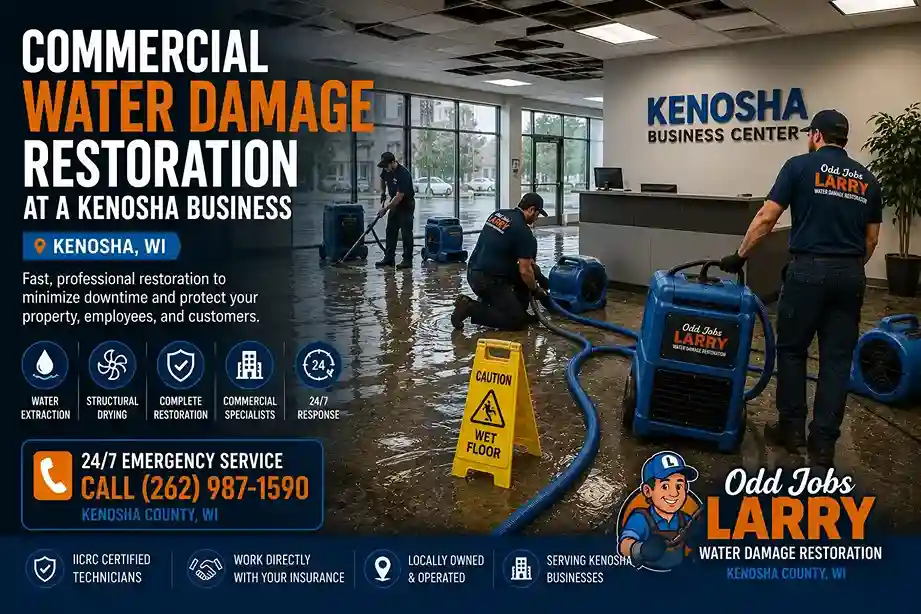
Protect employees and customers first, then stop the water source if it's safe to do so. Document the damage with photos, protect inventory and equipment, and begin emergency water extraction right away. Contact a commercial restoration company immediately, since a fast response reduces business interruption, inventory loss, and mold growth risk. Commercial restoration focuses on both property recovery and operational continuity, not just drying the building.
Commercial projects often involve larger spaces, more complex building systems, multiple occupants, and higher financial consequences from downtime than a typical residential loss.
More square footage means more equipment, longer extraction times, and more complex moisture mapping across the facility.
Tenant occupancy adds coordination challenges: notifications, access scheduling, and shared systems like HVAC and plumbing.
Every hour a business stays closed compounds business interruption costs beyond the physical repair bill.
Retail stock, raw materials, and finished goods often need rapid triage, pack-out, and climate-controlled storage.
Servers, POS systems, manufacturing equipment, and medical devices carry higher replacement costs and require specialized handling.
Restaurants, medical offices, and schools often face code and health-department requirements that shape the restoration scope.
Commercial restoration is planned around keeping critical operations running, not just drying and repairing.
Property managers, facility teams, and risk mitigation policies all factor into how work is sequenced.
Every property type has its own water damage challenges. Here's how we approach the most common ones across Kenosha.
Server rooms, ceiling tile grids, and carpeted floors need fast extraction to protect electronics and documents.
Merchandise displays and stockrooms are at risk; we prioritize inventory salvage and rapid reopening.
Kitchens, walk-in coolers, and dining areas require health-code-aware cleanup and sanitization.
Large open floor plans and stored goods call for large-scale extraction and desiccant drying.
Equipment protection and production-line downtime are the priority alongside structural drying.
Infection-control standards and sensitive equipment require careful containment and HEPA filtration.
Restoration is scheduled around occupancy and safety requirements for students and staff.
Multi-unit water intrusion needs tenant communication and unit-by-unit moisture mapping.
Public facilities require documentation and compliance-aware restoration processes.
Guest room availability and reputation risk make rapid, phased restoration essential.
Commercial losses in zip codes 53140–53144 commonly result from burst pipes, severe Lake Michigan-driven weather, roof failures, sprinkler discharges, and equipment leaks.
Aging supply lines in older Kenosha commercial buildings fail under pressure or freeze during winter cold snaps.
Flat commercial roofs and aging membranes let storm water into ceilings and upper floors.
Fire suppression discharges release large volumes of water quickly across wide areas.
Lake Michigan-driven downpours regularly flood Kenosha's downtown commercial districts and industrial facilities.
Rooftop and in-ceiling HVAC units leak condensation or refrigerant lines into ceiling cavities.
Commercial kitchen equipment, water heaters, and industrial machinery are common leak sources.
Category 3 contaminated water requires biohazard-level cleanup in commercial restrooms and kitchens.
Basement-level retail and storage spaces are prone to seepage during heavy rain and spring thaw.
Unheated storage areas and loading docks are especially vulnerable during Wisconsin winters.
Commercial restoration often focuses on reducing operational disruption while restoration work proceeds, not just on drying the building.
We section the property so unaffected areas can stay in use while damaged zones are treated separately.
Containment barriers and negative-air setups let work continue safely around staff and customers.
Extraction and drying equipment can run overnight or during off-peak hours to reduce disruption.
Plastic sheeting and negative-air chambers isolate wet areas from the rest of the facility.
Revenue-critical spaces, like a retail floor or production line, are addressed first.
Server rooms, refrigeration, and essential systems get priority equipment placement and monitoring.
Large commercial losses call for large-scale equipment and a documented, methodical approach.
Truck-mounted extraction units and commercial pumps remove high volumes of standing water fast.
Water that travels between floors requires extraction and drying at every affected level, not just the source.
Storm and flood water is treated as contaminated and extracted with appropriate PPE and containment.
Electronics, machinery, and sensitive equipment are elevated, dried, or removed before further damage occurs.
Salvageable stock is triaged, cleaned, and documented; unsalvageable inventory is logged for your claim.
Thermal imaging and moisture meters track water intrusion behind walls and under flooring across the whole facility.
Commercial drying relies on extraction, airflow, dehumidification, and ongoing moisture monitoring, scaled to the size of the facility, whether it's a warehouse, office building, retail space, multi-family property, or school.
Equipment and methods: LGR dehumidifiers, desiccant drying for large or humid spaces, psychrometric calculations to set drying targets, industrial air movers, and continuous moisture monitoring with drying logs documented for insurance purposes.
Commercial restoration follows a structured process of assessment, extraction, drying, cleaning, and repair, documented at every step.
A live technician answers 24/7 and dispatches a commercial crew immediately.
We evaluate electrical, structural, and contamination hazards before entry.
Photos, thermal imaging, and moisture readings are logged for your insurance claim.
Truck-mounted and portable extraction units remove standing water across the facility.
Air movers, LGR dehumidifiers, and desiccant systems dry the structure to verified targets.
Antimicrobial treatment and HEPA filtration address contamination and indoor air quality.
Drywall, flooring, and structural repairs restore the space to pre-loss condition.
Moisture meters confirm the structure is fully dry before the job is closed out.
Hidden moisture in wet insulation, ceiling cavities, and wall systems is the most common source of commercial mold problems, and it also affects indoor air quality for employees and customers.
Mold can begin developing within 24–48 hours if materials remain wet. Fast extraction and structural drying are the most effective way to prevent it. Learn more in our guide to commercial mold remediation after water damage.
Property managers benefit from documented response plans and clear communication throughout a restoration project.
We coordinate access and scheduling across units without disrupting every tenant at once.
Clear updates on timelines and access needs keep tenants informed throughout the project.
Photo logs, moisture readings, and drying reports support both insurance claims and tenant records.
We work directly with adjusters and provide Xactimate-based estimates for commercial claims.
We can help property managers establish a response plan before an emergency happens.
Phased work plans keep as much of the building operational and accessible as possible.
Commercial claims often require more extensive documentation and coordination than residential ones, and we build that into every project.
Written, itemized estimates give you a concrete number and scope before work begins.
Thermal imaging and moisture readings are logged throughout the drying process.
Daily drying logs provide evidence that the structure reached verified dry standards.
We communicate directly with adjusters to keep your claim moving.
We help document losses relevant to business interruption coverage where applicable.
Scheduling and walkthroughs are coordinated directly with your adjuster.
Commercial losses often overlap with these specific causes and recovery services.
Lake Michigan weather patterns bring heavy spring rain and storm surges that regularly affect commercial districts and industrial facilities across downtown Kenosha and the surrounding zip codes, 53140 through 53144.
Protect employees and customers first, then stop the water source if it's safe to do so. Document the damage, protect inventory and equipment, and begin emergency water extraction. Contact a commercial restoration company right away, since fast response reduces business interruption, inventory loss, and mold risk.
Within hours, not days. Mold can begin developing within 24-48 hours, and standing water quickly threatens inventory, equipment, and flooring. We dispatch to Kenosha commercial properties around the clock.
Often yes. We use phased restoration, containment barriers, and after-hours scheduling so unaffected areas can stay operational while we work on the damaged sections.
Most commercial drying takes 3-5 days, similar to residential jobs, though larger footprints, multi-floor damage, or Category 3 water can extend that timeline. Reconstruction adds additional time depending on scope.
Sudden events like burst pipes or sprinkler failures are typically covered under commercial property policies, while gradual leaks and sewer backup often need a separate endorsement. We document moisture readings and drying logs to support your claim.
Yes, especially without a fast response. Commercial restoration focuses on both drying the structure and minimizing downtime through phased, priority-area work.
Costs vary widely based on square footage, water category, and whether structural materials or equipment need replacement. We provide a written Xactimate-based estimate before work begins.
Yes. Mold can begin colonizing wet materials within 24-48 hours, and ceiling cavities, wall systems, and HVAC ductwork give it more places to hide in commercial buildings. Fast extraction and structural drying are the best prevention.
Live technicians answer 24/7, every day of the year, for commercial properties across Kenosha, WI.
📞 Call (262) 205-8618 Now